Sunday, August 1, 2021

In Conversation, with Will Alexander


DC: How are you holding up, Will? What’s new? What have you been doing to stay sane during the pandemic?

WA: The pandemic though morose and solemn for planetary culture at large inscripted my presence with an ironic oasis where the prior grasp of the world dissolved and further clarified my understanding of its dissolution. The circumstance has allowed me to focus insight over and beyond its grammar of turbulence. New lingual spells appeared unbidden for me because the territorial forces of the culture were momentarily stilled. Its interim allowed me to ruminate on the fertility of language itself which meant that a quaking of phonemes transpired which led to the phosphenic explosion of what I continue to realize is none other than lingual mystery. An eloquence of range not as transposition but capable of delving into the improvisersatory state that is living. 


DC: In much of your work, and with The Combustion Cycle specifically, there is this notion of the “I” that seems almost larger than life itself, or as large as life itself. When you are speaking from the perspective of the Henbane Bird, for example, the “I” possesses a unique simultaneity. You seem to not only be speaking from your vantage point as a specific human being with a specific point of view, but on a larger scale/perspective, simultaneously speaking from the Henbane Bird’s perspective, your specific perspective, as well as the perspective of humanity as a whole. Your “I” seems to connect all of the worlds “in there” and all of the worlds “out there.” How has your approach to the “I” managed to stay so fluid over the years?

WA: The 'I' which I've employed has remained transpersonal since the inception of my writing. By the time it had evolved to what was to be The Combustion Cycle it had become analogous to an inner nano sail translating its powers to unimaginable zones and distances. This is how the imagination has evolved for me always broadening its scale never recognizing expected linear cultural boundary. This understanding was seeded by Surrealism, not in an ideological sense but as a kind of inner ozone that freed me from the bombastic utterance of linear detail. An utterance of range transpired and evolved into a hyper-range not unlike the concept that is the nano-sail wandering unimagined vacuums. This wandering not only covers distance but also sonic alteration of phrasing but creates sonic alteration as distance. Equational trans-function not entrapped in itself as circularity. I call this compound suggestility which creates alteration as it continues to exist not as bound or orchestrated tautology. This creates range as unknown faculty. What transpires is that energy rises and becomes an improvised element without remaining riveted to a tedious concourse. The unexpected summons exhilaration. One ceases needing mechanical levers. As was stated many years possibly attributed to Breton when the verbal current seems to internally run aground just start the next phrase with a word beginning with the L. Praxis at this level has allowed us to go beyond these early stages so that in-grown ignition suddenly ignites and takes off as unplanned wizardry. I feel this to be a higher more inclusive field of comprehension.  A qualitative understanding not strictly tied to ideology or conscious political fragmentation but literally an evolved more comprehensive faculty that creates its own facility. Not a state based on a prior of information that by the nature of its energy attracts the accuracy of future states. 


DC: The way you read and the way you approach readings seems to be heavily influenced by Jazz music. I admire the element of improvisation in your readings. Although I don’t know that I’ve ever heard you refer to yourself as a “Jazz poet.” As far as American poets and the evolution of language are concerned, do we truly understand the richness of debt we owe to our fellow American Jazz musicians?

WA: This question brings me to my initial great experience improvised collective music universally known as Jazz. When I first listened to John Coltrane ignite Afro Blue was an experience of felt language. I knew the sound was not a condensed strategy but enabled itself as a communicative energy. Its pulsation felt right. Hearing Monk and Dolphy the intervals felt right. Then listening to Elvin Jones, Max Roach, and Roy Haynes I understood that a non-standard approach could be applied to the same medium. As I started to express myself in the English language I understood these same principles applied. I would just apply the presence of life to language and an equation would form and begin to yield verbal satisfaction. But as Max Roach once pointed out this is hard work and not the user friendly manner of paint by numbers. Charles Mingus once said find your own originality. This remains a gamble at all stages. Nothing is guaranteed except the unending search for verbal gold. Life within this tenor evolves as unmatched quintessence. 


DC: What do you make of this society’s current predicaments with and approaches to the exploration of outer space?

WA: As humans we remain within a dangerous presence. We have to a large degree been convinced by the mantra of unstable wish. If you take the word belief it has evolved from the Latin term which means to wish. When combined with distance and uncountable stretches of time how does the Occidental standard of human time compare? I am more inclined to a philosophy of natural integration with the flow of time itself. Not the body as a random barrier set in opposition to a state of reality that has fostered it. The latter being the Occidental mainstream that is showing extreme fatigue as a harbinger of failure. When I saw reference to a sun that was supposed to be only 39 light years away I knew right away that general value system remains doomed. Not via ideology or religious belief but the manner in which one mathematically feels language as accuracy not unlike the balance of a painted canvas or the accuracy acknowledged that flourishes inside of indigenous mathematics. As I've recently related the nearest actual sun system to Earth is 25 trillion miles away. To approach in linear terms remains a disaster no matter if Russia, China, and America launched a combined fleet of nano-sails it remains a combined enterprise of hubris. 


DC: Is creating art the most viable shamanistic endeavor available, in today’s society? What other ways do you see present-day shamans positively influencing and/or healing their people?

WA: For me my basic enterprise is creative language. Language can internally transmute capacity allowing neural connection to deeper states. An evolved neural capacity. So for me language remains the operant value, but as we opened with the capacity of music. What makes the modern state so blinded and tragic remains its compartmentalized human strategy to various areas of life. The only power it accepts is visible force, this being power that prevails by what I'll poetically call Roman Strychnine. Obviously what I am speaking of is not a transcendent bank account or momentary athletic prevalence. I am thinking of methods that invoke protracted inner sustainability.


DC: What are your motivations for creating art, music, poems?

WA: For me creativity remains a mantra and wells up from what I consider to be mysterious alter vents.  A precarious strategy to be sure but one effective by means of protracted sustainability. 


DC: You recently released quite a generous offering of poems in The Combustion Cycle. How has the reception of The Combustion Cycle felt to you? What kind of feedback are you getting from readers and listeners?

WA: The reception from The Combustion Cycle has been fabulous both critically as well as sales wise. I say this not out of false modesty but there are at least a half dozen books to appear after it. Three are poetry, and one on old Islamic scholarship entitled On Dar El-Hikma, and two books of essays from Litmus Press stretching into 2022 and beyond.

Theater of Impotence, Mike Corrao

 Dramatis Personae: YOU

Setting: YOUR ROOM


Act 1: YOU are torn apart on the flickering screen of a box computer monitor. ASCII graphics spreading and condensing. Every glyph is a particle in the wave. Corrupted notes rise as excitations. YOU note each corruption on your interface. The notes form a rudimentary image. YOU see something. The outline of a figure of personal importance.


Memory is a fragile object made of time and language.


The outline of a loved-one is the blurring of a poem.


You are a WEEPER. You weep when you can’t tell who this is.


You cut the meat from between your thighs.


You throw it into the ocean. The ocean turns red.


Act 2: The screen is a stage for procedural performances. YOU perform a scene from a play titled, “SCAB SCHEMA” which has you reading incoherent babel. Half-formed sentences with bolded terminology. Words like “generative,” “incipit,” “birth.” YOU feel as if you are being mocked. I don’t know by what. A ghost in the machine. Something underneath the luminous darkness. SCAB SCHEMA, YOU assume, is a play about growing new skin. Post-ecdysis. Post-injury. The directions tell you to tear away the skin beneath your knee. It doesn’t say which knee. YOU do not want to. Your hand does so anyways.


The script of SCAB SCHEMA demands utterance. It demands to be spoken, brought into the physical realm. The interface is capable of uploading information into your head, but it cannot force you into action. YOU are in control. YOU are the subject, but still YOU are in control. The object / interface shallowly guides your actions. YOU attempt to speak as the skin of your knees peels back from the muscle.


This is a work of performance. Did you not expect us to ask for you to perform it?


Is this your first time on stage?


Have you felt weightless? Have you been on a plane? Or levitated above a fire?


SCAB SCHEMA is a play about rebirth. Have you ever been reborn?


ACT 3: The flesh beneath your knees burns in the open air. Blood seeps from the spaces between muscle and bone. At first like water, and then like mucous. Welling in dense globules after the pressure has caused it to coagulate. Thin red streaks run down your calves. “SCAB SCHEMA” regenerates. A new scenario appears on your interface. A new set of lines and directions. YOU skim the lines before uttering.


The monitor glows luminous in the distance. The black screen somehow bright and almost blinding in its darkness. YOU feel the desire to move inward. To investigate the artificiality of this void. But YOU do not. YOU remain where you are. Awaiting further instruction. Awaiting the full render of this script. YOU open your mouth and let SCAB SCHEMA speak through YOU.


SCAB SCHEMA is a work participating in the Theater of Impotence.


Continuing the traditions of Artaud’s Theater of Cruelty. Have you seen his soft face and smoothed chin?


The Theater of Impotence is spawned from an inward cruelty. Reflected back onto the self.


The stage is a place for self-flagellation and castration.


SCAB SCHEMA is a play about shortcomings. It is about the skin of your knees that will not grow back, or that will grow back shittier.


Cross-hatched and discolored.


ACT 4: YOU are sitting at a desk with a stack of books on digital fabrications and virtually-oriented architecture. O(rphan)d(rift>) cyberpositive, Architectural Intelligence: How Designers and Architects Created the Digital Landscape, Supra Systems, The Second Digital Turn: Design Beyond Intelligence, The Alphabet and the Algorithm, Interface for a Fractal Landscape, CCRU Writings 1997 - 2003, Generative Strata, Lonely Men Club, anything that might remotely lead YOU to the site radiating these auras/ transmitting these frequencies.


YOU attempt to find an archive of previous SCAB SCHEMA iterations. YOU want to collect them and perform them once again. Stepping onto the projected stage and pretending to lift and dance around with its set-dressings. But instead YOU receive a new generation of scenes. They tell YOU to photograph the blood streaks on your shins and to scan them onto this database: aaaaaaaaaaaa  when you are done. YOU obey.


The Theater of Impotence is the conversion of self-exile / self-punishment into art.


In which the actor is a prisoner. And the audience is a jury.


The performance text is a geographical object.


It is a labor-source. The generative cell of potential action.


Do you not read the play as if it is a manual? Or the instructions for assembling a futon?


Do you not read it knowing that you will obey?


ACT 5: YOU read three hundred books. Scanning over every word until YOU are no longer capable of seeing. SCAB SCHEMA infects the interface and crawls into your brain. It tells YOU that YOU must feel the text. Let the interface glow through your eyes. Coil around your optic nerve. The new lines are regurgitated onto your tongue, constructed from the remnants of previous scenes. The generative cells of the procedural process are jury-rigged into your skull. A rudimentary computer spawns a new dialect of whining technobabel.


The eyes are a film camera.


The stage is a projection of certain desires.


We cannot ignore the virtuality of the Theater of Impotence--the role of software in its creation.


The labor of the performance text is accelerated by the procedural-generation of lines.


SCAB SCHEMA is a tool for creating endless utterance / a schizopastoral landscape.


The skull is a housing for teef.


The skull is a housing for yet-to-be-spoken words / proto-utterance.


SCAB SCHEMA is the initiation of these mechanisms.


The Theater of Impotence is a categorization of the mechanisms’ actions.


Do you know what you are doing? What intentions you have in being here?


I do not mean to mock you. I only mean to question your presence here.


SCAB SCHEMA is a play about your own self-induced amnesia / forgetfulness.


The performance text is a diegesis capable of annihilating history.


The labor you perform on its behalf is the construction of a new reality.


In traditional theater, this reality is temporary.


In the Theater of Impotence, it is a replacement for the corporeality of your birth.


SCAB SCHEMA is your migration into the virtual mise-en-scene.


MIKE CORRAO is the author of three novels, MAN, OH MAN (Orson's Publishing); GUT TEXT (11:11 Press) and RITUALS PERFORMED IN THE ABSENCE OF GANYMEDE (11:11 Press); one book of poetry, TWO NOVELS (Orson's Publishing); two plays, SMUT-MAKER (Inside the Castle) and ANDROMEDUSA (Forthcoming - Plays Inverse); and three chapbooks, AVIAN FUNERAL MARCH (Self-Fuck); MATERIAL CATALOGUE (Alienist) and SPELUNKER (Schism - Neuronics). Along with earning multiple Best of the Net nominations, Mike’s work has been featured in publications such as 3:AM, Collagist, Always Crashing, and Denver Quarterly. His work often explores the haptic, architectural, and organismal qualities of the text-object. He lives in Minneapolis.

Selected Works, Anthony Seidman

 Strata

The origin of red ants…dandruff and itchy armpit.  The origin of wine, as much the grape as the hindquarters of a roan stallion.  They took his toys away and he wept, he railed.  The origin of sharks…the fluttering moth and insomnia, or twitching of nervous left foot.  As an adult, they built a wall between his hands and lover.   Her black hair turned into an octopus.  That was the origin of a pistol and obituary.  The erasure of lizards with wing-spans like the red wood, a thunderbolt deep in the desert.  The razing of cheap housing, linked to mushrooms and the thinning population of possums.  The origin of mathematics: an eclipse, a legion of crabs covering the esplanade.  After she died, he paused to hear the wind and voice of insects.  He knew the ants were stitching a scripture of venom.  The madmen sniffed and laughed.  Its ending is its origin, he said, picking up a handful of mud to smudge a target in the center of his chest.


Why Desire Rhymes With Fire

A fragrance of strawberry pervades the city and syntax turns aquatic.  Now wine pours blue and rinses mud from eyes buried in work-boots.  This means a season of coitus.  The couple flutters past the purple curtains of their window, and the great thumb and forefinger pins their flame-tinctured wings against the moon.  Fireflies now inhabit caryatids.  Lighthouse at the tip of cigarette.  Sphinx holding a bouquet of roses and the mantra of the staircase and garret which brims over with the fragrance of fruit.  The boy scribbled plum and sky against the white construction paper.  Scribbled and the paper opened.  Lianas, bewitched.  A weather like syntax became humidity.  Words proved to be water, and just as ambulatory.  The boy was laughing.  The jilted bride picked up the pillow with His name embroidered.  She put the pillow to her ear.  Heard an alarm-clock ring.  The white gulls in the wind desired, then expired.


Crew Cut

The origin of open windows…blue umbrellas and ribbons.  The origin of delight…scissors, diorama of ant tunnels, zippers.   Childhood remains something locked inside an empty DVD case.  Adolescence sticks to one’s fingers and making art out of paste and construction paper results in a telepathy not different from ice floes or microorganisms feeding a lake the color red.  As a boy, he loathed piano lessons.  Crows perched on the staves, and his thumb resting on middle C ached for iguana rainfall and steam rising from asphalt.  The music he heard, an origin of hibiscus, or panther.  When his father died, he remembered his son’s birth.  The skin, violet, flushed with redness.  The origin of the death-rattle, infants bleating.   When they took away his toys, he wept.   He wanted the frigid dens of the deep.  Ink spurting from startled octopi.  The origin of kites: the weight of water.  So much of street mutt originates from blue whale.  


Tanka or Tonka

A tough choice, like betting on silkworms or the rambunctious crow.  My uncle once rode my BMX bike into the deep-end of the swimming pool on a lark.   He left it there, much to the chagrin of my mother.  He died penniless and attached to a ventilator, for one can’t suck the oxygen from water.   Cherry petals and the exuberance of spring still remind me of the worm, of dark waters where the ship-wrecked regard themselves in empty mirrors.  I kept my toys outside, and the yellow tractors and trucks gathered sand in their axles.   Yellow, the color of death, the color of old pages in a novel once read aboard hundreds of cross-continental jets.  A barren rock.  A missed tryst.  The poetasters are painting ties and silk fans, but they know that toys rust.  My father died last November, and I can’t recall a thing about the leaves, the weather, the drizzle that did or didn’t lick the asphalt black.   I felt his death-rattle the way a spider detects a vibration on a silken thread.  All of the calligraphy in this century can’t cleanse me of his gnarled grip. 


Kerotakis

Now the Verb reaches me via conduits and commixtures: fruit of silence breaking flower into scarlet, cartilage and nerve, tamarind, lemon, sulfur, the opened triptych of thighs whose center panel sweats midnight.  In this velvet one can’t distinguish camembert from cabernet.  Is that grease coagulating on the fields, redolent of garlic and mashed cilantro, or the blackest earth, indistinguishable from blood clotting, bull on hilltop, vinegar pouring on the valley?  You Oh Verb rise from the tar.  Heaven bubbles with stars and comets.  I have levitated, float out the window among black roses, towards the hotel named after your toes.  I am reading your hair and sniffing your accent of feverish fans and machetes.  Rose of panties scrubbed with soap and left in the shower’s stall.  Rose of haunted mansions torched centuries ago.  Rose of expired postage stamps and kite caught in oak branches.  Rose of Rosa, whose name rhymes with everything molten and mortgaged, like atoms, train station, molasses, ivory.  Bells, clanging? 


Anthony Seidman is a poet and translator from Los Angeles.  His most recent collections are The Defining Crisis of Your Lifetime Is Utopia (Trainwreck Press) and Cosmic Weather (Spuyten Duyvil).  His full-length translations include A Stab in the Dark (LARB Classics) by Facundo Bernal, and Confetti-Ash: Selected Poems by Salvador Novo (The Bitter Oleander). He has published translations, poetry, reviews, and essays in journals like New American Writing, Poetry International, Black Herald, Ambit, Modern Poetry in Translation, and in the anthologies Poetics for the More-Than-Human World (Dispatches Editions) and The Ecopoetry Anthology (Trinity University Press).


Thursday, July 1, 2021

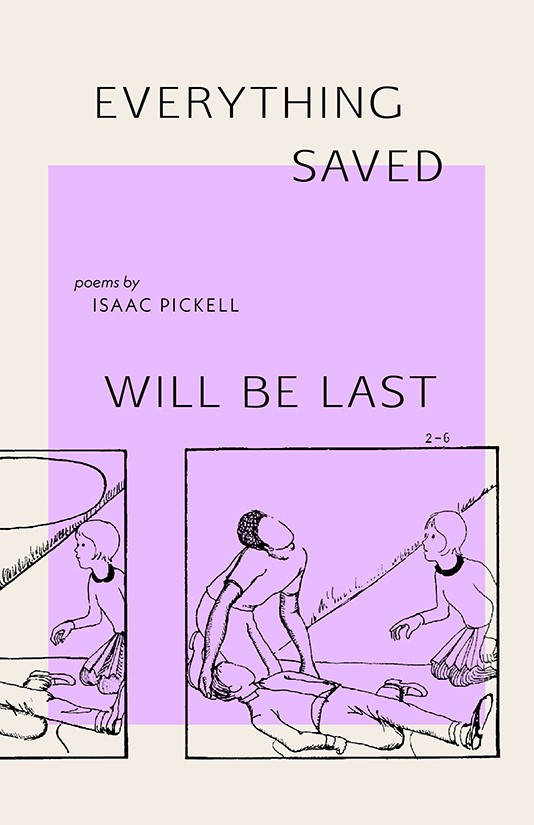
Excerpt from EVERYTHING SAVED WILL BE LAST, Isaac Pickell


Everyone applauds the bravery of the past

Amelia Earhart was
eaten by a giant

crab and digested
just like any other adventure—

some way to die.
some people are just gone

even before they’re gone,
prodded with careless

panic children reserve
for fire. but is there any

difference in desire
and deference?


writing yourself whole

let your body consume
metaphor like everyone

has a body, like you have
had eyes for too long

to learn new tricks; change

the mirror instead. if you find
some body missing do not

report to the authorities, call the
number at your perforated edges

stapled to trees and signposts, do not
present a problem without a solution

because you will get used to it; remember
there is actually no difference between good

and bad things. it is impossible to remember

the others as young men; let your body age
with their memory. time will take shape painlessly

about you no matter how closely you watch the pot.
accept the diagnosis that makes none of this your fault,

accept someone else’s lies as mantra: gratitude and complaint
are not mutually exclusive, hold yourself closer to the vest. do not

conflate skin cells with history, politics and other sciences
pretending I am unimportant, reciting: no ideas but in things.

no mountains but from molehills.


name/brand

on a windy day breaking
those hottest Midwestern months

where most everything is
wishing for death

or winter, a single dried petal
from that little blue flower

with a cute colloquial name,
shrunk beyond its living

weight and crumbled a bit
on its edges, falls

from somewhere that is not
knowable to the backseat of your car

in a park, the kind with trees
and paths but not a path

through the trees, surrounded
by city and city

and suburb and trees and
something catches your eyes

in the sparse canopy, your whole
body follows until one is

captured and catalogued
by a benevolent satellite employed of a science

repeating, “When’s the last time you heard Michael Brown?”


To order copies of EVERYTHING SAVED   WILL BE LAST by Isaac Pickell, via Black Lawrence Press, click here

Excerpt from NOTHING OF THE MONTH CLUB, Jeff Alessandrelli


Your X-Rays Have Just Come Back from the Lab and We Think We Know What Your Problem Is

Indigent, shimmering, the pieces of reality that I like best are the ones that fit together so finely—minutes rubbing into hours unto days funneling themselves (aghast!) into years—that it feels like your whole life is a déjà vu, pervasive, splatters of consciousness at every edge and the accretion shards of sight and motion and sound, lived out whole.


Nothing of the Month Club 

Summer. We switched the colors in our town’s only traffic light to blue, pink and purple. Lo-card country-grade acid. A sun-soaked caramel apple, festering, steady the hour settles on my coffin’s cover. Loving freely and boring easily, I changed my phone number to CALIFORNIA. (The stupid screen’s still cracked, the screen’s always cracked.) Death is the one and only law with no flaw. Dust into dust. Don’t call me. Don’t text. 


Nothing of the Month Club 

Studying the bones in a blade of grass, squirms in a cube of ice, I’ve finally begun the major work necessary to finish my novella I’m a Man of Few Words, None of Them About Myself.  I’ve resigned myself to the cold storage world of America, everhard. I’ve committed myself to a constant erection of the heart, evertaut.

Living in the moment before dying into the past, living in the moment before dying into the past, living in the moments.  


To order copies of Nothing of the Month Club by Jeff Alessandrelli, via Broken Sleep Books, click here.


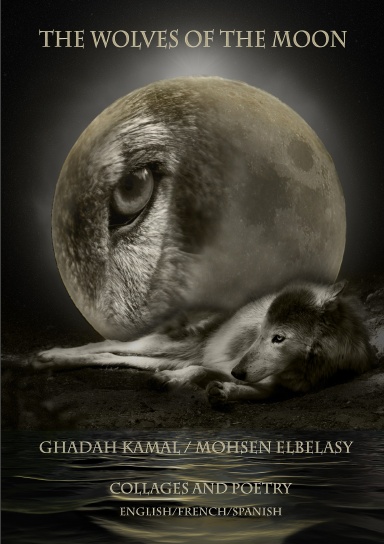
Excerpt from THE WOLVES OF THE MOON, Ghadah Kamal & Mohsen Elbelasy


The Poem is Dead

He was going on like a lost shadow.
He wears a red coat in the time of the murderous bulls.

As a skinny frog,
He sleeps in the debris of himself.
He eats a fresh death.

He jumps over desperate burning rocks.

The god poet died Leaving many old humans behind,
the heavy dust asking: What will you find 
behind the last fort of that hidden in the crystal?

The poem is dead in a slaver’s bed.
The poem died in a slaver’s bed.

And you…you are a jungle of old desires.

What?

How about a scene that hunted the butterflies of the impossible?

O dust, be a guitar
…So it is

Be a man wearing a coat of pianos that’s playing a symphony
of falling debris and thirst.
Dance, dust, and spit out all the plague that 
inhabits ant heads in the squares.

On the Sonnet of the broken roads…
dance and be a burning smack that breaks the
monotony of the dying shadows.

The nigh passes.

And the butterflies of the dream explode like a death…
Line-in-line, extended colors in the oysters of fading.
And the blood of the sheep woven with handcuffs
that are hanging over your head,
it forms an eternal wreath of gum

Dear poet…
You are a tomb saturated with the penultimate smoke of death…
The bells of Negation strike your broken neck.
Your chest graves sing the rush hour…
You are nailed to the wall of spiders with looters hats…
Fluttering over thorns of waiting…

Red like water
Blue like fire
Black like air.

O painter

Many locusts come and fly over your color palette…
Locusts and more locusts
Bleeding and more bleeding

O painter

Do not make from the Drawing board what the
butcher does when he decapitates the utopian lambs…
Make your painting a delirous microscope that
does not lie in the gypsum logic shrouds…

Draw crumpled handcuffs and a bottle of wine
bearing the reddening of the crowd of screams…

O musician…

I do not want to hear anything that brings me to death…

O musician

Play something like a tight fist with faces that don’t kneel
And from the noise draw a hammer
Little by little write letters that do not fly from the chimneys…

O vague, burning mind

Explode
Or you died in silence, mixed with pallor
Mixed with fear…

O hand that is filled with volcanic eyes…

Slap me on my unhappy face, break it so that it won’t fall
into the tissues of spiders and the upper hanger of the pigs…
Until Obsessive dies and is replaced by a new void…
Here on this dirty, bloody street…

The poet wolf was killed
With mixed tears in his black blood, stretched 
And the night flowing from his mouth on the
sidewalks of expatriation.

Your street where all the keys are lost, burdened with locks,
you will die like the god poet and like the poem.


The Store of the Damaged Brains

I will open a store that sells damaged brains.

My goods will not be expensive.

I will help idiots to look more stupid in the shadows.
The store name will be: “The Phantom of the Opera”.
Shelves contain brains at reasonable prices.
Human brains, monkeys, frogs, and crows.
It will be available to humas from now on,
to change their brains here in my store while dancing on;
(The Phantom of the Opera) music.

A young man was betrayed by his girlfriend, so he 
decided to replace his brain with a fish’s brain,
and in the village he became called, “the fish man”.

Another woman lost her son in the war, and she 
replaced her brain with the brain of a woman with psychosis.

and many stories…

One day a woman came without breasts and 
wanted to replace her brain with a tree,
they say in the village that she lost her baby in an 
air strike and cut her breasts, and
when we told her that we were not replacing
brains with trees.

She removed her severed breasts from between
her thighs, and shot everyone in the store.

The Brain Massacre was on music:
(The Phantom of the Opera)

The sky is raining frogs what a curse!

Only the hesitation of a woman raving at the 
beginning of the road.

The funeral of a soldier who returned from the
war without arms, and his mother made a wooden
body for him, as if it was a funeral for Pinocchio.
The sounds of war illuminate the boozers night.

The lights of the aircraft illuminate the bedroom 
of the prostitutes.

The air is saturated with death.

A woman without breasts, and
no heads looking for the trunk of the tree.

Neither head sings loudly:

I feel the shade is more honest
under the shadows our hidden features appear,
there in the shade we all look like each other.

Dogs are dogs
Humans are human beings
Monkeys become monkeys.

Do you think that is why those stuffed inside
expensive clothes are afraid to walk in
the shadows?

I knew a woman who loved to draw shadows
She changed her eyes every day

There is a store on the edge of town
It sells used eyes at discount prices.

And one day, she decided to sell her tongue and
buy a new nose.
She stood in front of her shadow,
and she pulled her tongue out,
and she cut it while she was laughing.

Then she remembered that’s he wanted to sell her
breasts and replace them with two gears.

She looked at her severed tongue and cried.

The closed rooms are full of spiders.

The ceilings are spiders’ homes.

How happy!

I imagine how happy I was when I was hanging
from my feet in the ceiling of the room.

I watched everything silently and I made a guitar
to turn it into a spider’s web to attract all
those I dislike to it, and melt them with acid in the
shades of the room.

I am not a spider but I love the wooden frog, and I 
love
its collective croak…
Like a symphony walking at the shadows of the night.

Oh if I were a wolf…
I love wolves that live only in the shadows.
Dance
Howls
in the shade

Then she walks around herself in an acrobatic dance.

She kills herself by the trunk of the tree,
wailing,

Falling frogs, a soldier without limbs,
a woman with delirium
a store for body parts
Boom
Bomb’s sound
screaming

(Translated by Mohsen Elbelasy)


The Symphony of the Curly Eyes

Curly eyes
Wingless butterflies
A single artery crucified on the wall.

Boxes of Sulfur without ceiling

Black bags at the clinic’s door
The clinic packed with hanged fetuses

The smell of blood smells from Butcher’s shops.

The voices of the birds are begging on the edge of the altar,
the Crows are waiting for massacre

Children cuffed in uniform on the edge of the
sidewalk waiting
Drunks go back to their holes.

A woman spreads her underwear and bedding,
To mesmerize the world
with what her beauties did with her Bull at night.

Banner of the doctor who injects Botox inside
hearts.

Billboards about Beauty, and 
Billboards about new compounds,
Lame old bus.

At the edge of the end of the road,
there is a woman who embraces two children,
and there is a Music coming from some home,

and the trumpets of cars.

Then she embraces her babies And jumps in the 
river.

Again

The girl smiles at the entrance of the clinic
Welcome to our liposuction clinic.
Voice in front of black bags.

Boy, carry these stinky bags.

The birds at the edge of the altar are crying,
and the crows are screaming,

Then a woman floats over the Nile.

(Translated by Mohsen Elbelasy)


To order copies of THE WOLVES OF THE MOON by Ghadah Kamal & Mohsen Elbelasy, via Lulu, click here.

In Madness, Yuu Ikeda


Only while madness is
hovering in my hands,
I can draw mad shapes of stories

Only while madness is
screaming in my hands,
I can make mad shadows of stories

Madness is energy
to bloom in gloom
Madness is fuel
not to wilt in needles

Only while I feel madness,
I can feel alive,
I can feel my blood

Madness is a shield
to endure woe
Madness is a blanket
to stop trembles