Friday, March 1, 2024
Selected Works, Barton Smock
Monday, February 26, 2024
Three poems from Apophenic Epiphanies, Steve Carll
the word is celebrate again
tufted fuzzy with foreshortened awea fantasized emblem for stargazing tenterhooks
open your disheveled community so
a makeshift paradigm can sleep its way to the top
5/16/2021
glory bee and hallelujah honey
a frontline occupancy terrifies the odalisque rep
mainstay cave-in vocalist opens nostalgic interpretation chambers
after advising salutary mobster refreshments
a pop-top fiddler-crab hermitage would envy
eckankar welcome ceremony takes note
of the western brain hemisphere
a selection of fine irrelevancies
a turnip’s alternative
poetics of gesture--or was it gestation?--
overhang the gas station of pleasure
5/17/2021
gallant intrusion into sacred space
the automorph weaves selfing-words
that leave attention invisibly invited
the arrangement to flower relentless
concentric rings of concentrate-forms
apply mystery to organic infrastructure
5/22/2021
Steve Carll lives with his family in Arcata, California. His third full-length poetry collection, Hypnopompic Diaries (Books One and Two) is forthcoming in 2024 from Alien Buddha Press. Earlier books include Tracheal Centrifuge (Factory School, 2006), Tao Drops, I Change (with Bill Marsh, Subpress, 2004), and several chapbooks. His work has recently appeared in SurVision, First Literary Review – East, and Reap Thrill. From 1988-1998, he edited the literary journal Antenym. Performance video of most of his poetry from 1991 to the present can be found at https://www.youtube.com/@stevecarll/videos.
Wednesday, November 2, 2022
Excerpt from THE DIRECTOR'S CUT, John Yamrus
Excerpt from A Spontaneous Prayer, David Hay
Wednesday, December 1, 2021
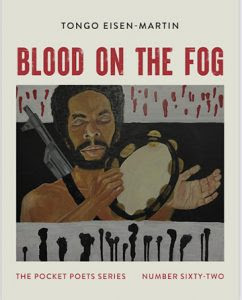
Excerpt from Blood on the Fog, Tongo Eisen-Martin
I Make Promises
Before I Dream
No unclaimed, cremated mothers this year
Nor collateral white skin
No mothers folding clothes to a corporate park preamble
No sons singing under the bright lights of a lumber yard
Quantum reaganomics and the tap steps of turning on a friend
New York trophy parts among
the limbs of decent people
Being an enraged
artist is like
entering a room
and not knowing what to get high off of
My formative symbols/My
upbringing flying to an agent’s ears
I might as well be an
activist
Called my girlfriend
and described
All the bottles
segregationists had thrown at me that day
Described recent blues
sites and soothing prosecutions
I feared for my poetry
You have to make art every once in a while
While in the
company of sell-outs
Accountant
books in deified bulk
Or while
waiting for a girl under a modern chandelier
Or in your last lobby as a
wanderer
The prison foot races
the museum
My instrument ends
I mean, what is a
calendar to the slave?
Also, what is a
crystal prism?
“He bought this bullet,
bought its flight,
then bought two more”
The Cycle of Black Mercy
Well I have at least fallen around love
Reading poems next to my friend with Loisaida fire escapes
in their teeth
Talking about the gun I’m going to bring to the segregation
Trying to protect children with poems/protect these store-runs
Avenue nights as a hospital bard
I can’t make out the system of craft
Is this run the house dust circuit/are these abandoned
houses of various rank
art here like karma-less soldiering
Falsifying my first solo on this stage/ on this rickety
enemy-ness
Ladies and Gentlemen, here to make some warmongering of
your night
these receipt paper poems
Adorning my red eyes with a self-inflicted fatherhood
Over-policed eyes
state impressionism bouncing back and forth between skin
and ski mask
an emotional range or wobbly self-portrait
amongst these church giants
calcified personas present /grown man depression
scraping cotton against uptown silhouettes/see in their
shadows all manner of bombs
king of the poems, baby
genuine marvel of the history of poems
welcome to the mild bourgeoise
revolution street fairs/our weariness
well-proven socialism/ the death of both your and my
hip-hop, Lord
make your green back ruling class confetti/art somewhere in
this
earn stripes with three hands/cut God off of your shirt
look out at the world from the inside of an ink stroke
I don’t mind the Mississippi steel, sir, but may I have a
saxophone from a different city
bright lights/lethal injection routine/last words/Is My
Family Here
take all disrespect as the universe in motion
I write poems today
I kill america today
five-year anniversary of my style
(swamps talking/ midsize
activist files like songs sitting under the street/
Slave castles growing and growing/
keeping notebooks
alive the wrong way/
human temper
sitting still)
going to Afrika in mysterious ways
the harp that turned the hand toward the Founding of Chicago
you know what my trick is, grandson?
I am weak first
Before anything, I first become weak
Kick a hatchet down the street/ then all around a city
a grandmother’s Milwaukee
or the gods my grandmother robbed
fresh faces in the spirit house/ a spirit house we’ve put
behind the sun
We have God’s permission to make a plan
Gradually, the poem becomes decently empty
You know, be weak
Let the ability to write slip
until only one fingertip
is left on the handle
then, in a flash, return
with a slave castle in a cup of change
“Lady’s and gentlemen:
We assure you that tonight’s entertainment is not judging
you…We paid them…really well”
Free Fear
The boss belongs to the masses now
Got the boss’ likeness on a string like a love poem
Wild stride speeches replace memories of the boss
We got machine guns in the communist bar tonight
We are naturals in the communist bar
Our boundaries are just a little death
We stand outside the gates of San Francisco
listening to some good
preaching
“Congratulations, your
mercenaries hurt.
Your Money Jungle
hurts. Your mouths hurt.”
“Merchants of frenetic
white flight
Luckless and
(therefore) well-armed primitivism
Reaching down into the
patterns of your soul
Making for funny
stories”
“I hope they didn’t
name any schools
While they had those
kids in those cages”
Joy returns to decent revolutionaries
Puts a hermitage
in the fascism
Saint Faluja thumping, your shoulder is family
and needed
God crawling in between the bullet heat
Yes, our grandparents’ God
Thought experiments in the last words of Black organizers
Let’s make a
periodical of their last words, Lord
Of the remaining
addresses of Black power
We become Angola on both sides/A humor of axes.
A foot race through public property/remilitarized
Pork improved/Celestial pork
Platinum minted pork/choose your words carefully pork
“the first mirror was
clay…the first human was not”
Humanity recommencing
near the weight pile
(would be nice to sound
universal)
not
heroin owed
heroin
passing messages
heroin
left laying around an empire
A colonized
intellectual as a guest
in their own hand
It’s like a life’s work
depends
On replicating
Birmingham caravans
Or particulate
Birmingham
One to five shells flying
at the state capital
Signed, “Thank you for
the resources”
big band scatting up the throat of a surrogate fascist
in love with their one eye ball
at the parade with tuxedo-colored guns
marrying the cowardice
A re-running white politician
Is born in a Black neighborhood (taken as a stage of
history)
Born of a Black Messiah (taken as a foco-biography)
Is born Black (journey’d)
Legislates in some
dimension fused to the side of loud steps
copper summer riots, but still some blood involved
still some necessary slums involved
rag tag armies masked in western height/ in primary emotions
Delight of cocaine both warped and not warped enough/images
can be cousins
What happens when you step outside the country’s sugar
gorging?
What good are you all to the world sitting in Heaven?
Who are we going to lay out books for?
Who’s going to touch the knives at night and sing to the
gaps in between shadows…gaps between our love?
Who is going to teach our knives to sing Tobacco Road
Teach them that they are family
Picture a Black socialist in a perfected boneyard
in a tributary boneyard
whispering to cheek bones
dimming the wind
A Black socialist who will live for one hundred years in
this graveyard to make this point/that we’re in too much pain for naming
ceremonies... that ancestors need to inflict on the world our continuity...
A thousand good deeds decorate the 20-year police precinct
janitor
A janitor (who called it)…who knee-slides, but not like you
Telling you of a half-dead humanism to pass the time
A math teacher and their little red book
“I used to dream of revolution… and even enjoy the dream”
Tongo Eisen-Martin is the Poet Laureate of San Francisco, California. He is the author of Heaven Is All Goodbyes (City Lights Books, 2017), which was shortlisted for the Griffin International Poetry Prize, received the California Book Award for Poetry, an American Book Award, and a PEN Oakland Book Award. He is also the author of someone's dead already (Bootstrap Press, 2015). Blood on the Fog is his new collection of poems.
INTERMITTENTLY LIKE LOUISIANA RAIN & Other Works, Jessica Alexander & Vi Khi Nao
PAGE 25
I have decided to overlook your wife’s air conditioner and subatomic particles
PAGE 27
SATURN’S TACTITURN
I haven’t been alone too long
I please everyone I can
I can’t live like this anymore
I have no problems saying no
This way of ridiculing women has to be stopped
The car forgave and I enjoyed its subservient
engine
He flirts just like a carton of milk
The poet no longer resists
But refuses to be a God in her own house
Someone is about to have a bowel movement
Have I been good to you?
Mr. Insincerity is blocking
I don’t know what street to cross
Desiring: I refuse to forgive
Oracle: death defenses itself
She’s a queen
Also she uses the vibrator too much
I have stopped talking to her
Have you been lazy lately?
I didn’t spell her name right. Could you smell
it?
From afar it does make noises.
But have you talked to the pig?
The barnyard has transformed.
This is not the right way to love
Don’t turn the engine back on.
PAGE 29
ABDUCTION
Polygraphs and Omar the screwdriver.
In a strapless dress
Made for typhoons and artificial intelligence.
The clue is in the hue.
I take results however superficial.
Fly without a working engine.
Conical hats
Sanitized rats.
Forever so kind.
Distrust for the impossible.
Unsexy hip.
Ear glistening
Aborting strangers
PAGE 31
The poem is asleep: narrow monarch tea, red red
that can’t
dismiss a dream, and swims like an
antiquated icicle.
aggression was a landscape
by Jessica Alexander
In Pittstown voices hovered over the gnarled trees, the orchards, the barns, and the splintered roof beams. If you hear them, you must not look up. If you hear one in dusk, in a clearing—let’s say you’re splitting wood or gathering something maybe mushrooms—you must bend your eyes and your being to the axe, you must exert yourself and keep it out.
In Pittstown Mary walked the gloomy streets. She wore fur and strange and stunning gowns. Clara darned socks inside the splintered light. I am drowning. Clara said to herself and the voice was not inside her head, but her stomach, like an echo deep inside a well. I am drowning. Mostly, Clara felt like this, save when she saw Mary in such strange and stunning gowns.
At midnight, when her father prayed, Clara would walk to the cold rock, toward the dead orchard and the cornfield, where the stalks poked through snow and swayed against a sky unbearable and grey. Clara would wait for Mary in the orchard, and Mary would appear in something silk and soft or fur. “Do you like it?” Mary said. She stroked the gown with Clara’s hand, and like a deer Clara grew very still. Everything, her skin, the sky, the splintering wind became an instrument through which to perceive her friend. “Yes,” she said, “I like it.”
In Pittstown, aggression was a landscape. It was in the angle of a doorframe, the way a root broke through the cold dirt. It was too much, at times, to simply turn your eyes to something else. No one spoke of it. Clara’s uncle, Thomas Wieland looked nothing like Thomas Wieland. Mary said, “That’s not Thomas Wieland,” but, of course, no one believed her because how the fuck would she know. He looked twenty years too young to be him. He’d recently arrived, or so he said, from Austria. He was a surgeon. He was an artist. She became his apprentice. “Put on this,” he said and flung a gown at Mary’s head. His room was spare and untidy. It was without comfort. There were reams of ink stained paper, a surgeon’s kit, and a trunk stuffed with silk dresses. “Don’t touch that!” He shouted and hurled his commonplace book at Mary’s head. The first page said “The World as My Will and My Idea.” Mary stole it. Thomas was drawing her. He called these portraits the “Progress of a Woman of Pleasure.” But there was no pleasure in Pittstown. There was only Clara kneeling in the orchard. There was only Mary in her dresses. Sometimes there was laughter in the orchard, and the birds scattered, and Clara’s father looked at the sky and said, “What is that sound?”
INTERMITTENTLY LIKE LOUISIANA RAIN
by Jessica Alexander & Vi Khi Nao
In Salt Lake, I walked the neighborhoods
on winter nights, guided by the warm blue glow of windows and tv screens, flickering on the snow. Even this cold
loneliness contained
the balmy promise of a someday.
NOW the
flamboyant neon style of Gunpowder Milkshake spatters the blank walls of our
unconscious minds with sequined bowling lanes and diners & even the whites of our eyes are glittery.
I love this movie!
& our someday & Michelle
Yeoh - the great martial
screen artist - & look at that vest
& surely these are lesbians!
Yes!
Or are they baiting us, with a breathy death so
easily mistaken for a bloody kiss? And if you want it
bad enough, it is. It was a good
movie. All the men
were bad and the women, who killed
them, seemed to like each other. It was a really good movie, we agreed. The bowling jacket, an homage, maybe.
Today’s potential equity raise raised only your eyebrow. I watched you across the kitchen table as you tried to do some proprietor math. Leah has been an agent of alacrity and the
university may be scared of her. I soaked mung beans in a small pot and placed our bath towel
over it like Djokovic - after losing the first set and then second and eventually the last to Daniil Medvedev - placed his
towel over his head. Meanwhile,
we need white and green onions for the canh
khoai. I also wanted to walk with you because my period is heavy and
I had taken a photo of cotton
or a wintery
storm in the Denver light. The sun behind you and its shadows plaster
themselves across your back like a Pollock.
The air is cool and
you ran through the
park where they were setting up a
screening of WestWorld. The street smelled incredible when you rounded the corner and a man in the narrow alley hid a spliff behind his back and
you jogged past. Two girls with enormous dogs
stood in the park.
Earlier, at the grocery store you bought onions, chocolate, and salt. I made pork and soup and the broth turned purple. We ate spicy tofu bites packaged individually like small candy and our lips
burned. The sunlight is crisp and clean & the air never shimmers with
heat.
Phone wires are
full of birds and nostalgia. The air smells like
fresh cut grass. Now that the joyless cop show is over, what will we do with our
evening and our afternoon?
We walked beyond the railroad track, under the bridge, and through the tunnel with its electric graffiti
headdress. You asked about Qi. You asked if your body was open and if
there was a door to
your life force. We walked and
walked, walking past the
pile of trash which soiled the elegant and clean architecture of the RiNo Art district. We
walked past The Hub, the pole
dancing class, the Walnut Liquor store, and the city opened her long, athletic
legs to us. There were so many pathways into the future of our nomadic exploration. When we walked back to Natural
Grocers, you were holding in
your arms two babies: an
aluminum water bottle and the
Bread and Butter Cab, which you said
I loved and which you got for us when we visited Farwall in Shreveport. From across the railroad track, we could see faintly
the Zeppelin Station from our peripheral view. When we took the elevator to the
4th floor of our Blueground, you were holding a box of ginger
beer, ginger chocolate, one Bosc pear the color of the sepia earth before
mankind ruined it with greed and
capitalism.
You hated Superman & Lois
though Tyler Hoechlin’s teeth were sharp and white
as a wolf’s incisors and Bitsie is the name of the actor playing Lois and this appears to be her only real
misfortune. One reviewer wrote: the show brings the superhero brand back down to boring
earth. But I liked the premise: would superman make a good father? Though I think a daughter
may have been more interesting than two teenage boys. It failed the Bechdel test by a long shot. I don’t think two women
spoke to each other in the pilot, though there were three women in it. You found the premise of a small town gone awry somewhat compelling. You enjoy small town
conspiracies and small town
America taking on the corporate world. But Lois “the greatest journalist in the world” was unbearably basic and lacked the
ambition that made her a little dangerous in former iterations. She
was a fearless journalist, who much to Superman’s chagrin, was almost always about to get killed. One review said Superman
spends too much time blinking at his family in handsome concern and darting
around the stratosphere that he never can anchor his family or his show. I did not know how bored you were until we switched to Nevers and the deft and dapper Victorian ladies, twirling parasols and pithy phrases, roused you from your stupor.
After showering, we walked to
the grocery for
bacon and a gluten free muffin.
The light was both lambent and
radiant, coating everything we touched or saw with a sheen of translucent
warmness. Denver has such clean air. If you were in Lafayette,
there would be sunlight, berated
by sporadic bursts of rain and lightning. The air there is thick and muggy as if the city has been hooded by a black bag, tossed, and kidnapped into a moving, get-away van. I don’t like the idea of your natural oxygen tank being kidnapped by a city that only loves you intermittently like
Louisiana rain. We woke unexpectedly
late. Though at 6 am, my eyes were wide like long windows in a high rise office in New York. I tried to close them, but my nipples were
becoming electrical poles as if a wire
traveled between my cunt and nipple, and birds needing to take a break from their long flights could
land on it for rest and mindless repose. Our periods have made us tired. We sleep early now. We make love less. Our pads soaking in useless iron.
Last night, you
fell asleep at 9 o’clock. Tonight you’ve reserved a table at a winery with outdoor seats. You’ve been looking up galleries. We need to go to Walgreens but exhaustion overtook us. You slept while I finished blending sweet mung beans
and tapioca. They do not collect the trash on
Fridays or Saturdays. Though they
seem to vacuum the hallways on
Saturday mornings. If you look out
the window long enough you’ll notice the
yellow fence & the ferns that burst from behind it, the
gravel lot where cars park, and
the broken wooden crates that rest
against aluminum siding. This
is a city still being built with empty lots
where trash gets tangled in the weeds, gravel
lots, steel beams - and on the main strip a
string of new apartment complexes sit empty as old
warehouses, some breweries and wineries startle the sidewalk like an old friend in an empty airport. On Friday night a live band played at the beer garden, and the train scooped lumps of people up and
dumped them on the sidewalk like scoops of icecream or that Twombly painting - they shuffled up the street pushing bikes & sipping beers from cozies. I think of the castrated photographer, pushing his bike through
snow to my doorstep
every night, and all the gifts he gave me that
I shoved into a box inside my closet. On Saturday morning, the streets are
deserted. There’s a slight breeze. The sunlight and the air is so clean
the slight chill is crisp
but not 51 degrees as our phones
inform us, by 1 o’clock the city will inch it’s way to 90.
VI KHI NAO is the author of six poetry collections: Fish Carcass (Black Sun Lit, 2022), A Bell Curve Is A Pregnant Straight Line (11:11 Press, 2021), Human Tetris (11:11 Press, 2019) Sheep Machine (Black Sun Lit, 2018), Umbilical Hospital (Press 1913, 2017), The Old Philosopher (winner of the Nightboat Prize for 2014), & of the short stories collection, A Brief Alphabet of Torture (winner of the 2016 FC2's Ronald Sukenick Innovative Fiction Prize), the novel, Fish in Exile (Coffee House Press, 2016). Her work includes poetry, fiction, film and cross-genre collaboration. She was the Fall 2019 fellow at the Black Mountain Institute: https://www.vikhinao.com
JESSICA ALEXANDER’S novella, "None of This Is an Invitation" (co-written with Katie Jean Shinkle) is forthcoming from Astrophil Press. Her story collection, Dear Enemy, was the winning manuscript in the 2016 Subito Prose Contest, as judged by Selah Saterstrom. Her fiction has been published in journals such as Fence, Black Warrior Review, PANK, Denver Quarterly, The Collagist, and DIAGRAM. She lives in Louisiana where she teaches creative writing at the University of Louisiana at Lafayette.